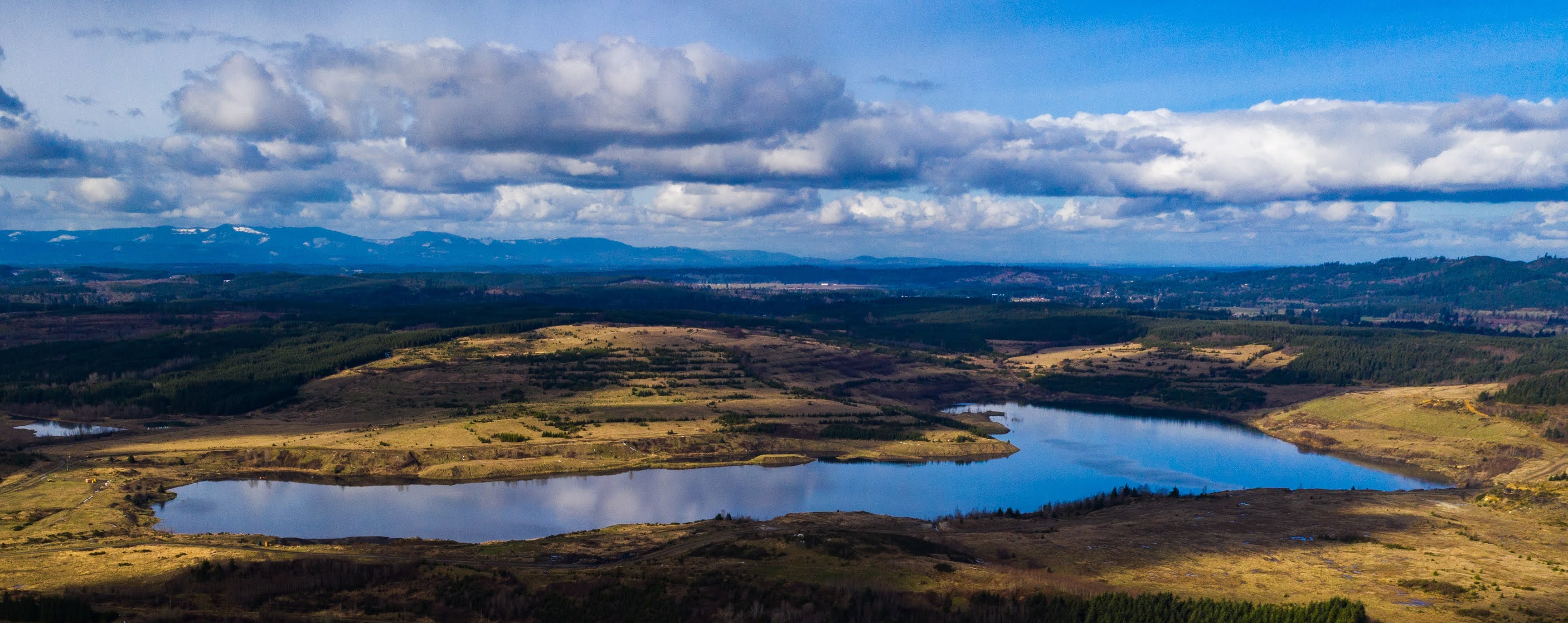
Back in 2021, the Washington Department of Fish and Wildlife sought to acquire the former Transalta coal mine near Chehalis/Centralia to turn it into a nearly 9800 acre wildlife area. Unfortunately, political interests interfered and got the project paused, seemingly indefinitely. This represents a tragic and frustrating setback for outdoor access to a surprisingly beautiful landscape which many people don’t even know exists. The mine has been reclaimed, and is now a vibrant tapestry of prairie, forest, and numerous sparkling lakes. In short, the community here has one of the most beautiful landscapes in the region on its doorstep, yet is unable to set foot there.
Transalta was going to actually donate the land to WDFW. It is in essence a free 10,000 acre park full of immense potential for outdoor access, just waiting to be unlocked. I would propose to expand the area from what was originally proposed, in order to create a more cohesive visitor experience, but even just as originally outlined, the concept was amazing.
I suggest that we call this place the Chehalis Lake Country, and that it be managed primarily for wildlife habitat as was originally intended. However, there is also the opportunity here to establish extensive low impact recreation opportunities. It is not an exaggeration to state that a hiking trail system here could rival any other in the state for scenic quality and for a variety of terrain. It is also at an elevation where the trail system would be accessible year-round. This is important given the need to extend the economic benefit of tourism and outdoor recreation into the winter months.

This area would be particularly attractive during the spring flower season, potentially drawing in folks who might otherwise choose the Columbia Gorge or Eastern Washington as their destination for spring adventures. Many such areas are becoming badly overcrowded in this season, and Chehalis Lake Country could act as a much-needed pressure valve for those regions. Additionally, strategic planting of native deciduous species of plants and shrubs such as aspen, paper birch, big leaf maple, and vine maple would turn the area into an autumn destination as well. As I’m writing this article, Mt. Rainier National Park, North Cascades Highway, and other areas of the Cascade Mountains are being mobbed by hordes of leaf-peepers and larch-lookers. There is clearly a growing interest in shoulder-season outdoor attractions, and the Chehalis Lake Country could offer such experiences in a location that’s just a few miles off I-5.

To get an idea of just how enormous the opportunity is here, let’s go over what a potential trail network might look like. The Northern edge of the park would be located near the town of Bucoda. In fact, I would suggest having the border be contiguous with Bucoda Volunteer Park. This would enable residents and visitors to access the new park directly from town, which is precisely what is needed to boost the economy of small towns such as this. Across the ridge from Bucoda lies the long vanished town of Tono, which was entirely demolished as the Transalta mine expanded. Today the site is the home of several lakes, including one of considerable size. The landscape resembles rolling moorland, with wide prairie and groves of trees, inset by deep blue lakes. It is easy to imagine a looping lakeshore trail here, connecting with other loop trails rambling off into the meadows of the hills.

Southward of the closed coal fired power plant are even more vast areas of meadows and lakes which have been established in place of the former mine. These stretch far to the East past another former town, Kopiah, and terminate against forested hills North of Onalaska. A Southern trailhead could even potentially be established to provide easy access to residents of Eastern Lewis County. There is enough space here even to support overnight backpacking, with high ridgelines offering expansive views, and multiple access points would make the region attractive for multi-day visits and be conducive to repeat visitors. It’s the dream scenario for tourism and outdoor recreation in rural Washington State. Protected as a park, it will only become more wild and beautiful with time.

Leave a Reply